
In the last decade the thermal efficiency of houses has become increasingly important and sensible improvements have been achieved by enhancing the performance of windows, walls, roofs and foundations.
In New Zealand the progressive substitution of timber floors with concrete floors generate the most significant results for thermal efficiency of foundations.
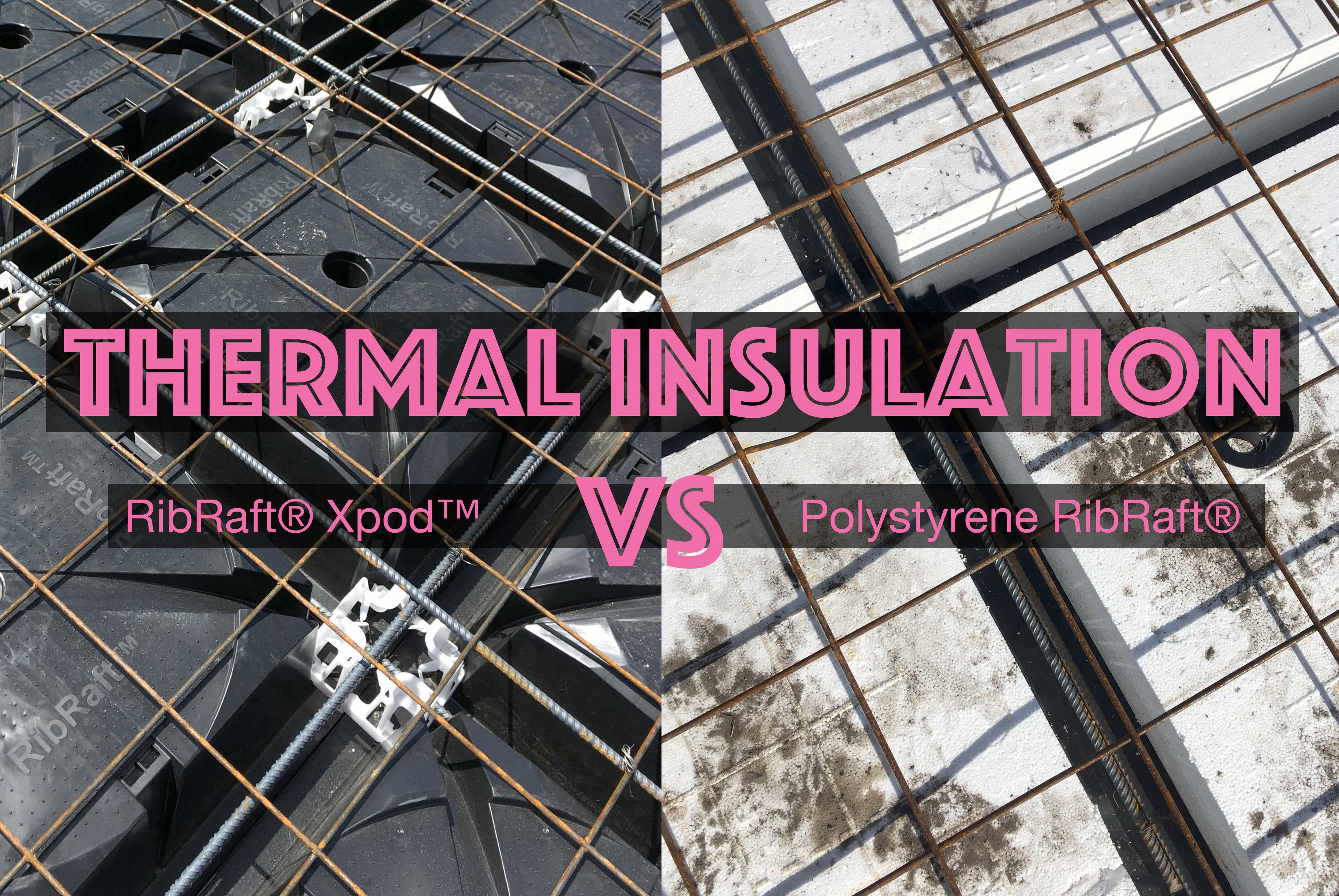
Furthermore, concrete floors themselves evolved from the NZS3604 traditional slabs-on-grade through the polystyrene waffle slabs to the recent RibRaft Xpod.
This article is aimed to answer one of the most frequent questions I receive:
“What is the thermal insulation of a RibRaft Xpod when compared to a polystyrene RibRaft?”
and the answer to this question is:
“The thermal insulation properties of a RibRaft Xpod are similar to a polystyrene RibRaft”
If you want to understand the rationale behind this statement I need to introduce some concepts and to provide some information about some requirements set out within the New Zealand Building Code (NZBC).
In building and construction, the R-value is a measure of how well an object, per unit of its exposed area, resists conductive flow of heat: the greater the R-value, the greater the resistance, and so the better the thermal insulating properties of the object. (1)
In New Zealand, the minimum R-Values required for floors are R1.3 for light timber frame construction, and typically R1.5 for masonry construction. R values of R1.3 can be used for masonry construction if glazing with greater insulation is used (refer NZBC, Clause H1). If in-floor heating is used the minimum required R-Value is increased to
R1.9.
The fourth edition of H1 (amendment 3, January 2017) states that “Concrete slab-on-ground floors are deemed to achieve a construction R-value of 1.3, unless a higher R-value is justified by calculation or physical testing.
In other words, from an insulation perspective, a concrete floor always complies with the NZBC when it is used for dwellings with double glazing and without underfloor heating.
For other cases, there are numerous methods available for a designer for calculating R-values, with many of the processes giving quite different R-values.
NZBC clause H1 prescribes that an “Acceptable methods for determining the thermal resistance (R-values) of building elements are contained in NZS4214.”
If the R-value calculation is required to demonstrate compliance with the Building Code, then the NZS4214 methodology is probably the best alternative due to its reference in
H1. This method also appears to have been used to calibrate the minimum R-values stipulated in H1.
For this reason, in my view, the correct pathway to demonstrate compliance with the limits set out in the building code is to follow the NZS4214 although it has been proven the results obtained with its methodology are often not accurate.

From the table above it appears that polystyrene RibRaft and a RibRaft Xpod have similar performance in terms of compliance to NZBC.
It also appears that, in some circumstances, the compliance to NZBC for dwellings with underfloor insulation can be achieved only by introducing additional insulation (e.g. perimeter insulation, underfloor insulation. See Is it worth insulating a concrete foundation?).
If the scope is not so much to demonstrate compliance to NZBC but to determine more accurate R-Values, then more technically robust calculation methodologies, such as two-dimensional thermal modeling, may be used.
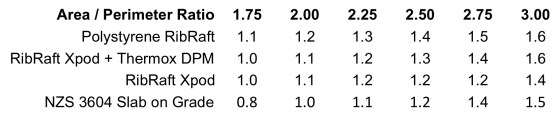
From the table above it appears that, in terms of its thermal characteristics, polystyrene RibRaft and RibRaft Xpod should be considered to be similar (although slightly better) than a concrete slab on grade.
In other words, it does not really matter if within a foundation polystyrene pods, air pockets or nothing is used: its thermal properties will end up being very similar.
Both for a polystyrene RibRaft and for a RibRaft Xpod, a large portion of the heat flow occurs through the thermal bridges at the ribs and the edge footings locations where they are in a direct contact with the ground and the external environment.
There is a simple way to explain such a counter-intuitive result:
You can put your hand at 10 cm from a burning candle without getting burnt. This is possible because of the excellent thermal properties of air that insulate your hand from the flame.
But what happens if you hold a piece of steel onto the flame? Very soon you will get burnt!

In this configuration the insulation provided by the air is compromised by the piece of steel that acts as a thermal bridge transferring the majority of the heat flow to your hand.
The ribs and the edge beams of the foundations behave like the piece of steel conducting a large portion of heat regardless the insulation offered by the polystyrene pods or the air pockets.
There are ways to improve the insulation of a foundation but the solutions are not always worth the investment and in some cases they might be penalizing for the structural integrity of your slab (See Is it worth insulating a concrete foundation?)
Luckily only a fraction of the heat loss occurs at the foundation location (because the soil itself provides some insulation) and only when underfloor heating is used the introduction of an additional insulation may be necessary.
Fabio Parodi
CPEng MIPENZ Dott.Ing(ITA) M.Eng(Hons)
CEO and Founding Director of Cresco
www.cresco-group.com
www.cresco.co.nz
(1) Source: https://en.wikipedia.org/wiki/R-value_(insulation)
(2) Sources: http://www.firth.co.nz/assets/Uploads/TechnicalDocuments/Ribraft-X-Pod-designers-guide-final-Feb-2018.pdf ; http://www.firth.co.nz/assets/Uploads/TechnicalDocuments/Firth-Ribraft-Technical-Manual-.pdf ; R-Values for some A/R ratios may have been derived from the sources by linear interpolation.
(3) http://www.firth.co.nz/assets/Uploads/TechnicalDocuments/Ribraft-X-Pod-designers-guide-final-Feb-2018.pdf ; https://www.buildmagazine.org.nz/assets/PDF/Build-143-78-Research-Perimeter-Insulation.pdf R-Values for some A/R ratios may have been derived from the sources by linear interpolation.
 lateral thinking.